
Case Interview Stress and Anxiety: How to Stay Composed Under Pressure (2026)
Practical techniques to manage case interview nerves, stay composed under pressure, and recover from blank moments with step-by-step methods.
On this page
Case interview anxiety is triggered by three conditions that rarely combine in everyday life: high-stakes evaluation, ambiguous problems with no single correct answer, and the need to think out loud while being observed. The result is the familiar experience of going blank precisely when you need to think clearly. The good news: interview composure is trainable. With deliberate practice, you can build a repeatable response to pressure before the real interview.
Why Case Interview Anxiety Differs from Regular Nerves
Most anxiety-inducing situations are evaluative but not simultaneously analytical. A job presentation makes you nervous, but the content is prepared in advance. A math exam is analytical, but not simultaneously evaluated through live conversation.
Case interviews combine all three stressors at once:
- High-stakes evaluation: Your career outcome depends on a 45-minute performance
- Ambiguous, unstructured problems: No single correct answer, real-time adaptation required
- Metacognitive demand: You must think AND explain your thinking simultaneously
Research on dual-task interference and performance under social evaluation helps explain why technically competent candidates can underperform in live cases compared with solo practice: they are solving, speaking, and managing evaluation pressure at the same time.
The practical implication: your preparation should include stress inoculation (deliberately practicing under conditions that partially replicate the physiological stress state), not just content mastery.
Build composure through deliberate practice
Road to Offer's AI interviewer creates realistic interview pressure with timed sessions and challenging follow-up questions, so stress inoculation happens before the real interview.
The 3-Phase Stress Response in Case Interviews
Understanding the stress arc helps you time your interventions.
Phase 1: Anticipatory anxiety (before the case starts) This can begin before the interview and peak just before the case prompt is given. Symptoms: elevated heart rate, shallow breathing, scattered thoughts.
- Intervention: Box breathing, light movement, systematic review of your framework templates
Phase 2: Acute activation (case opening) The moment the prompt is given, working memory can narrow. This is why candidates rush clarifying questions or skip structure time.
- Intervention: Deliberate 3-second pause before responding, written note-taking as an anchor
- Practice: Use a short case structure drill to make the opening minute automatic before you add full-case pressure.
Phase 3: Stabilization (once analysis begins) Once analytical work begins in earnest, many candidates feel more stable because they are back in a familiar problem-solving rhythm.
- Intervention: Maintain low-stimulation behaviors (no rushed speaking, steady pen pressure on notes) to avoid re-triggering phase 2
Breathing and Grounding Techniques
Box Breathing (4-4-4-4)
Used by athletes, performers, and professionals before high-stakes moments. The value is simple: it slows your breathing, gives your attention a task, and prevents a rushed opening.
Steps:
- Inhale through the nose for 4 counts
- Hold for 4 counts
- Exhale through the mouth for 4 counts
- Hold empty for 4 counts
- Repeat 4 times
When to use: Before the interview starts, and during any silent processing moment inside the case.
5-4-3-2-1 Grounding
A sensory grounding technique that interrupts anxiety rumination by forcing attention to the present environment.
Steps: Name 5 things you can see → 4 you can physically feel → 3 you can hear → 2 you can smell → 1 you can taste.
When to use: If you feel severe anxiety spiraling in the waiting room or in the 30 minutes before an early-morning interview.
Cognitive Reappraisal
Research by Alison Wood Brooks at Harvard Business School (2014) showed that telling yourself "I am excited" rather than "I am calm" before high-stakes performance produced better outcomes in singing, public speaking, and math tasks. The body's arousal state is identical between excitement and anxiety. Only the cognitive label differs.
Practice phrase: Before the interview, say out loud: "I am excited about this. This is a challenging problem and I like challenging problems."
Practicing Under Pressure: Stress Inoculation Protocol
Stress inoculation works by exposing you repeatedly to partial stressors until the threat response habituates and the analytical response dominates.
Level 1: Solo timed cases
Set a 35-minute timer and complete a case from prompt to synthesis without pausing. Score yourself after. This creates time pressure but not social pressure.
Target: 10+ Level 1 sessions before adding social pressure.
Level 2: Partner cases with consequences
Practice with a partner who is instructed to push back on at least 2 statements per case, ask for explanations of your math, and occasionally give you wrong information to test your error-detection. Add a rule: if you use more than 5 filler words ("um", "like", "so") in any 2-minute segment, the case resets.
See case interview practice partner guide for how to structure these sessions.
Level 3: Cold-start recordings
Record yourself being given an unfamiliar case prompt (have a friend send you a case via text 30 seconds before you start recording). Watch the first 3 minutes. Identify: Where does your voice speed up? Where does your eye contact drop? These are your specific stress signatures.
Level 4: High-stakes simulation
Do a timed, recorded case with a friend who plays an impassive interviewer (minimal facial expressions, no nodding, long silences after you finish speaking). This simulates the most anxiety-provoking interviewer style.
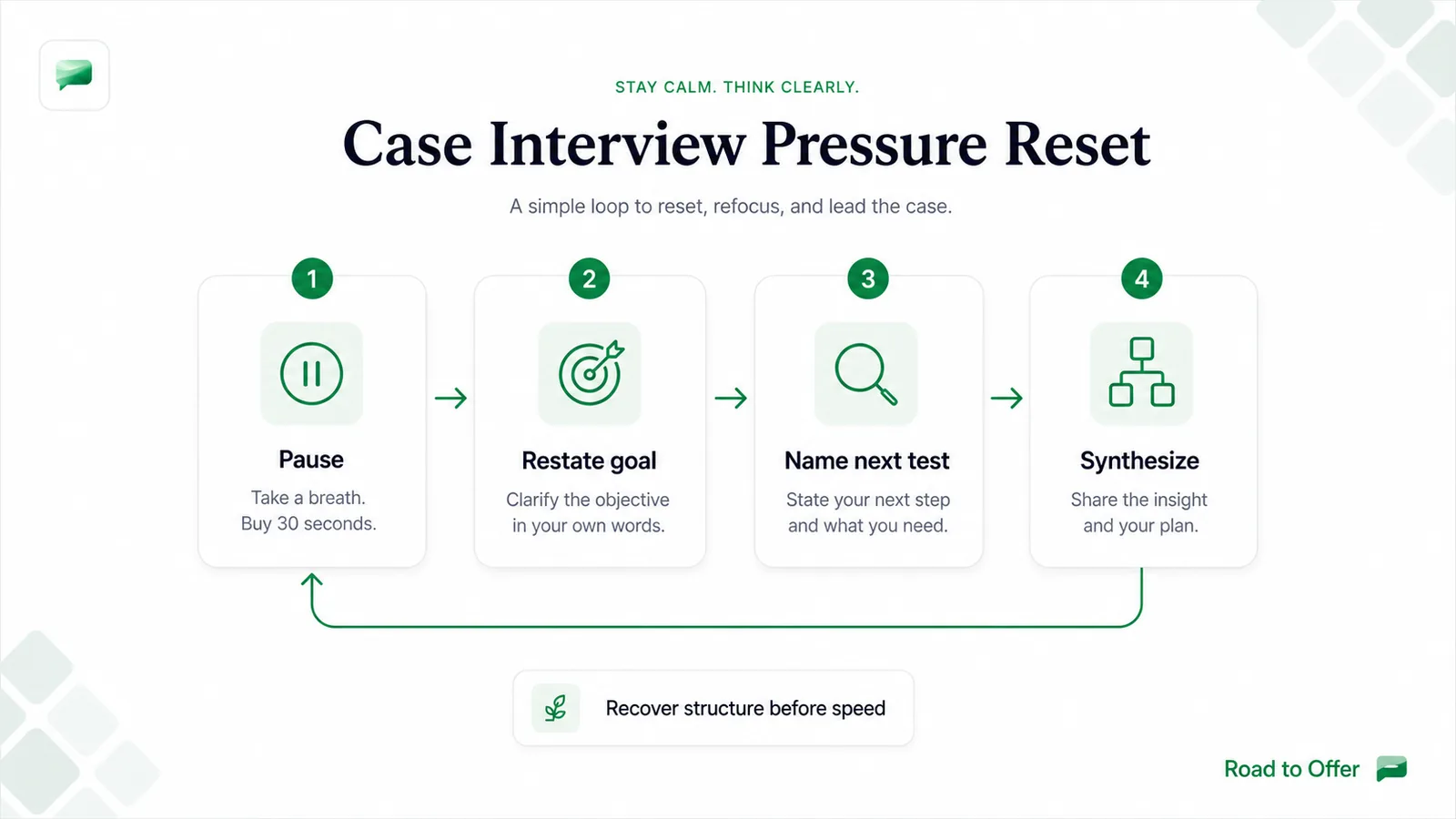
Recovering from a Blank Moment
Every experienced case interviewer has seen candidates go blank. It is not disqualifying. How you recover is what's scored.
The 3-step recovery protocol:
- Acknowledge without apology: "Let me take a moment to organize my thoughts here." (Do not say "I'm sorry" or "I don't know," as these shift the emotional weight to the interviewer.)
- Return to your framework: Look at your notes. Identify the last branch you explored. State it out loud: "I've looked at the revenue side. I haven't yet examined costs."
- Propose a direction: "I'd like to explore the cost structure, specifically whether fixed or variable costs have changed. Does that make sense?"
What a blank moment looks like from the interviewer's side: A clean recovery is usually better than pretending you are not lost. The recovery demonstrates intellectual honesty, self-awareness, and the ability to keep the client problem moving.
For more on the synthesis and recovery moment, see case interview synthesis. To rehearse the final answer under time pressure, use a focused synthesis drill after your next recorded case.
Body Language Under Stress
Stress body language signals that interviewers notice:
- Upspeak (rising intonation on declarative statements): signals uncertainty in your own analysis
- Touching your face or hair: a classic anxiety tell that distracts from content
- Hunching forward: projects low confidence; sit upright with your back against the chair
- Rapid eye blinking: associated with cognitive overload; slowing your speech also slows blink rate
The single most effective physical intervention: Before responding to any question, take one slow breath through the nose and place your pen on the paper. This 2-second sequence anchors you physically, slows your heart rate slightly, and prevents the rushed opening that comes from anxiety.
Preparation Checklist for Stress Management
Execution checklist
Practice box breathing (4-4-4-4) daily for one week before interviews. Habituates the technique so you can use it automatically when anxious
Complete 10+ timed solo cases before your first live practice session. Builds analytical baseline so social pressure does not overwhelm your skill level
Add 2 Road to Offer practice cases per week during the final month. Creates repeated pressure reps with timed prompts, interviewer follow-ups, and post-case feedback
Record 3+ practice cases and watch the first 3 minutes of each. Identifies your specific stress signatures: voice speed, filler words, eye contact drops
Practice the blank-moment recovery protocol 5+ times. When you go blank in a real interview, your trained response takes over automatically
Use cognitive reappraisal: say 'I am excited' before each practice session. Reframes physiological arousal from threat to opportunity, improving performance on analytical tasks
Use light or moderate movement before interview day if it helps you regulate. Builds a calm pre-interview routine without leaving you physically overstimulated
Complete at least 3 high-stakes simulations with an impassive partner. Habituates to the most anxiety-provoking interviewer styles before the real interview
Establish a pre-interview routine and use it before every practice session. Routine signals safety to your nervous system; consistency reduces anticipatory anxiety
Related Preparation Resources
Stress management does not exist in isolation from case preparation quality. The most effective anxiety reducer is high competence. When you know your frameworks deeply, the cognitive load of each case is lower, leaving more resources for communication and composure.
Review case interview frameworks complete guide to ensure your analytical foundation is solid. If you are in the final weeks before interviews, last-minute case interview prep contains a focused stress-inoculation schedule. For understanding how composure is specifically scored, see case interview scoring rubric.
Train your composure before it counts
Road to Offer's AI interviewer delivers challenging pushback, silent pauses, and unfamiliar case types, building the stress resilience you need before your McKinsey or BCG interview.
Sources and Further Reading (checked June 17, 2026)
- Brooks, A.W. (2014). "Get Excited: Reappraising Pre-Performance Anxiety as Excitement." Journal of Experimental Psychology: General. Foundational research on anxiety reappraisal.
- McKinsey Careers: How We Hire. McKinsey's official guidance on evaluation dimensions including personal impact.
- American Psychological Association: Stress Effects on the Body. Overview of cortisol and adrenaline effects on cognition.
- Yerkes-Dodson Law and Performance Anxiety. Original research on the inverted-U relationship between arousal and performance.
- Box Breathing: Cleveland Clinic Overview. Clinical overview of box breathing technique and evidence base.
Frequently asked questions
Resources and related guides
- Practice a real case interviewPractice
- Browse all free resourcesResource hub
- Accenture Salary Guide 2026 - Pay by Level and Career PathFundamentals · May 20, 2026
- Campus Consulting Clubs: Benefits, Recruiting, and How to Get InFundamentals · Jun 3, 2026
- Case Interview Cheat Sheet: Frameworks, Formulas & PDF (2026)Fundamentals · Mar 20, 2026
- Reapplying to Consulting After Rejection: Ban Periods and a Comeback Plan (2026)Fundamentals · Apr 1, 2026